


Guaranteed by CNC Tour

Hajj and Umrah Tours
Kutsal Topraklara Güvenli ve Huzurlu Yolculuk
Before embarking on a pilgrimage to Umrah or Hajj, visits are made to our relatives and other important figures in our lives. Prayers are offered.
Like Hajj, Umrah also begins with ihram at the places designated by the Prophet (Mikat). Ihram may be entered before the Mikat boundary. Mikats – Allah knows best – constitute the points of departure for humanity that spread across the earth after Adam. Ihram is a condition of Umrah and one of the independent obligations of Hajj.
If possible, a ritual bath (gusul) is taken before entering ihram; otherwise, ablution (wudu) is performed. Clothes, shoes, and head coverings are removed. One puts on the white ihram garment, consisting of two pieces. Shoes or slippers that leave the heels exposed at the back and the toes exposed at the front are worn.
With the intention of ihram, two rak’ahs of prayer are performed. In the first rak’ah, the Kafirun surah is recited, and in the second rak’ah, the Ihlas surah is recited. The intention for umrah is made. The intention for umrah is as follows: “O Allah, I intend to perform umrah, make it easy for me and accept it from me,” and the talbiyah is recited. ‘Lebbeyk, Allahümme lebbeyk. Lebbeyke lâ Şerîke leke lebbeyk. İnne’l-hamde ve’n ni’mete leke ve’l-mülk, lâ Şerîke lek’ “O Allah, I have responded to Your command with my words and my soul, I have submitted to Your command. You have no partner. I have responded to Your command and invitation wholeheartedly and faithfully. You have no partner or associate. Surely, praise and blessings belong to You alone. The kingdom is Yours. You have no partner or associate in any of this,” he recites the talbiyah.
With the intention and the talbiyah, ihram is entered and the ‘IHRAAM PROHIBITIONS’ begin.
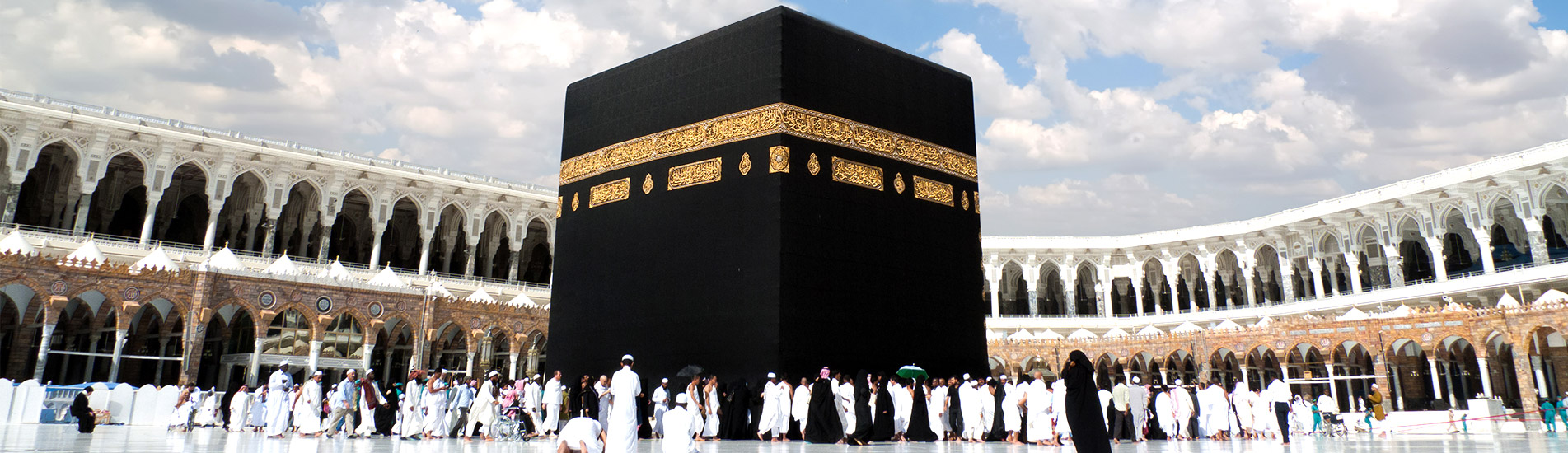
One comes to the corner where the Black Stone is located and makes the intention for tawaf on the line. ‘O Allah, I wish to perform the umrah tawaf for Your pleasure. Grant me ease and accept it.’ Tawaf is to walk around the Kaaba seven times with sincere feelings, starting at the corner of the Black Stone and ending at the same corner. Each of these walks is called a SHAVT.
Tawaf begins at the Black Stone and ends at the Black Stone. Remel is performed during the first three circuits of Umrah Tawaf. Remel is walking briskly with short steps, shoulders swaying, as if running lightly. Women do not perform the remel. Izdiba is when the person in ihram exposes their right shoulder during the tawaf; it is sunnah.
When starting the tawaf and at the end of each shawt, the right hand is raised slightly, turning towards the Black Stone, and the istilam is performed by saying Bismillahi Allahu Akbar. If there is no crowding and no harm will be caused to others, the Black Stone is kissed. During tawaf, people can recite the tawaf prayers from the prayer book, or any prayers that come to mind, or recite the Qur’an. When the tawaf is completed, two rak’ahs of tawaf prayer are performed at the Maqam Ibrahim (unless it is the time of kerahat). In the first rak’ah, the Kafirun surah is recited, and in the second rak’ah, the Ihlas surah is recited after the Fatiha. Then, at the place where the door of the Kaaba is located (called Multazam), the Multazam prayer is recited.
After Multazam, at least two rak’ahs of prayer are performed at the place called ‘Hatim,’ which is located under the golden dome and surrounded by a wall in the shape of a bow. Since this place is considered part of the interior of the Kaaba, the prayer performed here is considered to have been performed inside the Kaaba. After praying, the prayer to be recited at Hatim is recited. Then, plenty of Zamzam water is drunk. If possible, we pour it over ourselves and our bodies without wetting the ground. Then we recite the Zamzam prayer.
Say is the walk between the Safa and Marwa hills. Say starts at the Safa hill and ends at the Marwa hill. One trip from Safa to Marwa is called a shawt. One say consists of 7 shawts. One ascends Safa hill reciting takbir, tahmid, hamd, and salawat, and stops at a place where the Kaaba can be seen. One then intends to perform the Umrah sa’y.
One begins the sa’y by saying, ‘O Allah, for Your pleasure, I intend to perform seven shawts of Umrah sa’y between Safa and Marwa. Make this act of worship easy for me and accept it.’ Then one begins walking from Safa hill towards Marwa hill. One recites the Say prayers from the prayer book or other prayers one knows. One recites the Takbir, Tahleel, Salawat, and Hamd. When one reaches the two green pillars between Safa and Marwa, one performs the ‘Hervele’. Hervele is the name given to walking briskly and energetically. This is done to commemorate the memory of Lady Hajar.
Hervele is the Sunnah for each round of the sa’y. After the seventh round is completed at Marwa, the sa’y prayer is performed. After the sa’y is completed, men shave their hair from the roots or cut it short. Women cut a small amount of their hair. After shaving, they exit ihram.
Mekke
In Mecca, there are certain places that bear the traces of the Prophet Muhammad and his esteemed companions. Those who go to Mecca visit these places.
Sacred Places
- The House Where the Prophet Muhammad Was Born
- Mu'alla Cemetery
- Hira Cave, Gâr-ı Hıra
- Cave of Sevres
- Jinn Mosque
- Zubeyde Hatun water channel
- Muzdalifah
- Mina
- Masjid Bia
- Masjid Cirane
- Hudaybiyyah
- Masjid al-Hawf
- Tenim Mosque
- purgatory
Medina
Medina, the illuminated city, is the city of the Prophet from which the light of Islam spread across the earth. Every inch of it is filled with the memories of the Messenger of Allah and his Companions, who brought the light of Islam to humanity. It houses the greatest leaders of Islam within its bosom.
The Prophet Muhammad migrated here to convey the beauty of Islam to people, the Islamic state was established here, and the message of Islam reached humanity from here.
After completing his mission of conveying Islam, the Messenger of Allah passed away here and was buried here. Thus, Medina gained the honor of carrying within its bosom the most beloved servant of Allah and the greatest leader of humanity.
The Golden Age was lived in its most brilliant form in this city. The most beautiful, happiest, just, and equitable model society in human history was formed in this city under the guidance of the Prophet Muhammad.
Blessed Places
- Baqi Cemetery
- Quba Mosque
- Martyrs of Uhud
- Qiblateyn Mosque
- Seven Mosques
- Eris Well (Bi’r-i erîs)
- Masjid al-Ghamama
- Mosque of Abu Bakr (r.a.)
- Amberiyye Mosque
- Friday Mosque
- Mosque of Hazrat Omar (r.a.)
- Mosque of Hazrat Ali (r.a.)